· 11 min read
How to Tell If an Image Is AI-Generated: 7 Signs
People spot AI-generated faces just 48% of the time. Three free tools to verify any image in 30 seconds — from fake payment screenshots to deepfake ads.
A shopkeeper in Tashkent takes a 100,000-som note, holds it up to the light, then runs a thumb across the paper. Nobody taught them that. The habit is just there.
Nobody holds a Telegram image up to the light, though. In a 2022 PNAS experiment, people tried to tell AI-generated faces from real ones — and got every second one wrong. 48.2% accuracy. A coin flip. And that was against 2022 models, far weaker than today's.
One more fact raises the stakes: since April 2026, cars, real estate and other large purchases in Uzbekistan can't be paid in cash — card or transfer only. The banknote-checking ritual is leaving the stage. Its replacement is the payment-confirmation screenshot. And nobody has a ritual for checking a screenshot yet.
Here's the short answer: to tell if an image is AI-generated, stack three checks — a reverse image search via Yandex or Google, a close look at any text and shadows inside the frame, and digital-watermark detectors like SynthID and Content Credentials. Below we fit all three into 30 seconds. One honest warning up front: no method is 100% reliable — we'll explain why at the end.
The deepfake era: why your eyes fail
A deepfake is a fake image, video or voice made with AI. Your eye falls for it because AI draws exactly what your eye expects: trained on millions of real photos, it reaches for the smooth, average, familiar.
The PNAS experiment has a second act. Even after participants were taught the tell-tale signs and given feedback after every answer, accuracy rose to just 59%. The strangest finding came last: people rated AI-generated faces as more trustworthy than real ones. The reason is simple — our brains read "average" faces as safe, and AI aims squarely at average. A fake doesn't just deceive. It convinces.
This has already reached Uzbekistan. In March 2026, a casino ad "featuring" NOC chief Otabek Umarov spread online — the committee officially denied it. Before that, the Senate press service debunked a fake video attributed to its chair, Tanzila Narbayeva, a well-known Uzbek weightlifter's likeness was used in a deepfake, and Uzbek bloggers went public about AI-made "ads" featuring them. Western media calls this an online trust crisis — but the examples are already local.
One scoping note: most of those cases are video. This article is about still images; video and voice are their own topic. The gap is smaller than it looks, though — video is just images, dozens of frames a second. We covered how AI pulls this off in our explainer on how artificial intelligence works, and you can see what current models are capable of in our Claude Fable 5 post.
Fake payment screenshots and deepfake ads: what Uzbek businesses are already losing
Bluntly: money and reputation. Three schemes have gone mainstream.
How to spot a fake payment screenshot
The scheme is crude. A Telegram bot takes a name and an amount and, seconds later, returns a "receipt"
image indistinguishable from a real payment app's screen. In an OLX deal or a Telegram shop, the buyer
flashes that screenshot. The seller trusts it and hands over the goods. The money never arrives.
An important caveat: this is not Payme or Click being "hacked." The scammer never touches the system — they just draw a picture of its interface. That's why a screenshot proves nothing by itself; the only reliable check is in the protocol below.
Deepfake ads hit the brand instead. Following the Umarov pattern, scammers build casino and "investment" ads around a famous face; the fake Telegram accounts impersonating Tashkent's mayor are the same family of fraud. Now picture a customer walking into your shop saying "but you advertised this."
The third scheme looks small and quietly corrodes sales: AI-drawn "perfect" product photos on an online storefront. The delivered item doesn't match the picture — a return, a bad review, a lost customer. If you sell through Telegram, our Telegram Mini App article shows how to take payments inside the system, no screenshots involved.
How to tell if an image is AI-generated: 7 visual signs
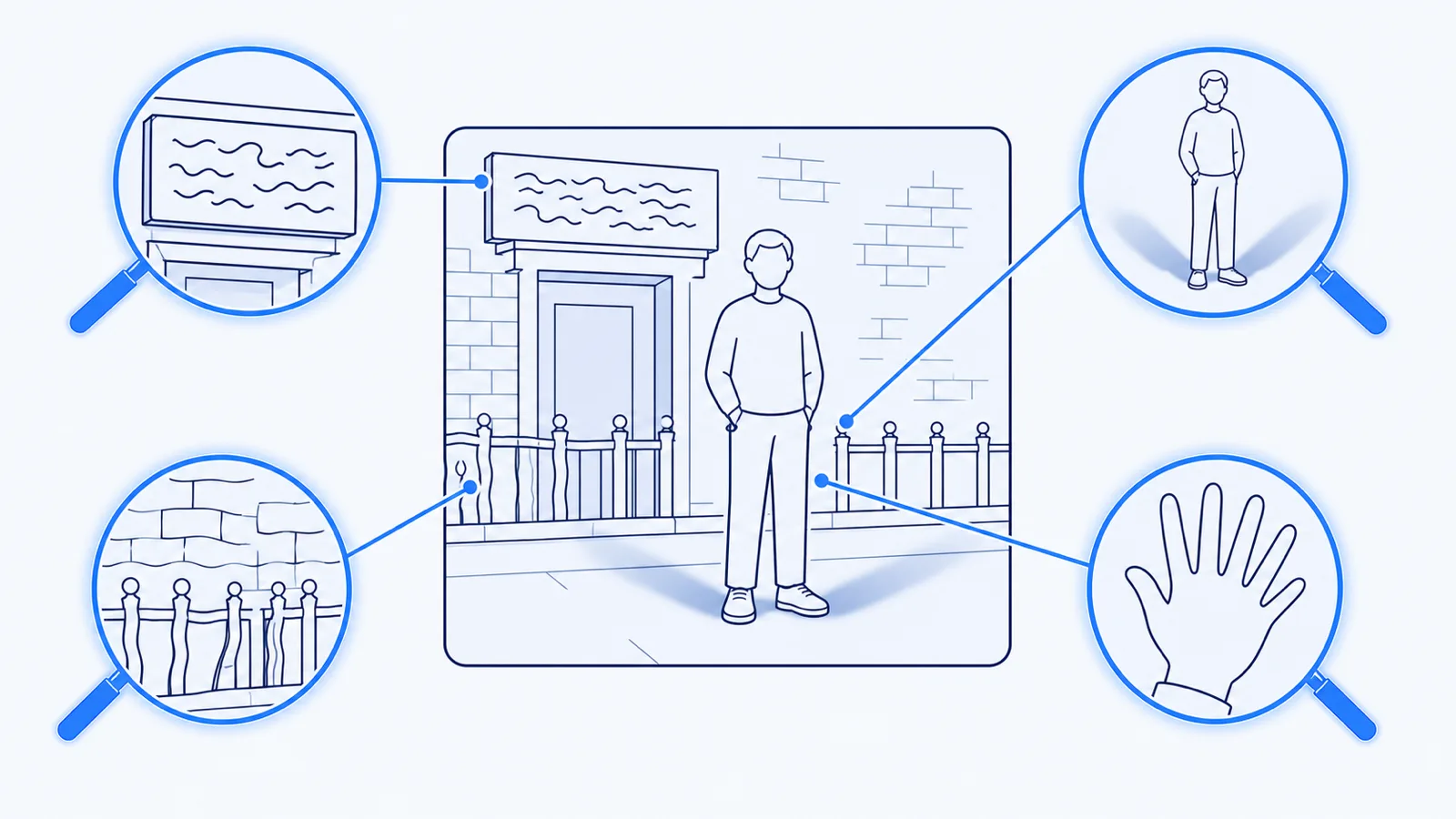
Most checklists online froze in 2023: "count the fingers." That's not enough anymore. Here are 7 signs — with an honest label on which still work in 2026 and which are past their prime.
| Sign | Where to look | Reliability in 2026 |
|---|---|---|
| Text inside the frame | Signboards, product labels, documents: letter-like shapes that don't read as words | High |
| Shadows and reflections | Mirrors, glasses, water don't match the scene; shadows fall in different directions | Medium |
| Background patterns | Crowd faces, fences, brickwork, carpet patterns "melt" as they repeat | Medium |
| Physics and proportions | A ring too big for the finger, a door too small for the person — sizes don't add up | Medium |
| Hands and fingers | Six fingers, impossible bends | Low — newer models fixed this |
| Skin texture | Waxy smoothness, hair strands fused into the background | Low |
| Symmetry | Mismatched earrings, different glasses temples | Low |
Order matters: check the text first — it's still the strongest signal. "Certificates," "diplomas" and receipts most often betray themselves right there.
Now the bad news. The eyeball ritual has already lost — even with money. As kun.uz reported, counterfeit $100 bills coming in via Turkey are 80% genuine elements with the rest hand-drawn — even the watermark is imitated — and closed Telegram channels sell them with the pitch "even ATMs accept them." A deepfake follows the same recipe: 80% real frame, 20% forgery. Banks moved banknotes from the eye to UV detectors; image checking has to make the same move.
Free tools to check if an image is AI-generated
One technique does most of the work: reverse image search. Drop the picture into Yandex Images or Google Lens ("About this image") and you'll see when and where it first appeared. For an Uzbek audience, start with Yandex — it indexes local and Russian-language sites better. This catches non-AI fakes too: an old photo recycled as a new event is still more common than any deepfake.
Then come digital marks. In 2026 Google built SynthID checking into Chrome, Search and Gemini: images made by AI tools carry an invisible watermark that survives cropping, compression and color edits. C2PA (Content Credentials) takes the opposite road — think of it as the image's digital signature: where a photo was taken and how it was edited is recorded with a cryptographic signature and verified at contentcredentials.org/verify. New Pixel phones already sign every shot at capture.
| Tool | What it detects | Limitation | VPN or account needed |
|---|---|---|---|
| Yandex Images | Where the image appeared before | Blind to a freshly generated image | No |
| Google Lens / About this image | First source and date | Same | No |
| SynthID (via Gemini) | Watermarks from Google, OpenAI tools | Can't see unwatermarked generators | Google account |
| Content Credentials | The photo's "digital signature" | A screenshot strips the signature | No |
One warning: no mark found does not mean the image is real — plenty of generators leave no watermark at all.
The 30-second protocol before you share
An image lands. Your thumb is already on "forward." Stop — here's your 30 seconds:
- 5 seconds — source. Who posted it: an official channel (kun.uz, gazeta.uz, the Interior Ministry) or an anonymous Telegram channel? In doubt, check factchecknet.uz, the national fact-checking site.
- 15 seconds — reverse search. Drop it into Yandex or Lens.
- 10 seconds — date and comments. Is the photo from an older event? Has someone already debunked it in the comments?
There's one more detector — your own pulse. If an image triggers anger, fear or shock, that's not a signal to share faster; it's a signal to check first. Fakes are engineered for exactly that button. An earthquake rumor, a currency spike, a gas-and-power panic — those are the moments a neighborhood chat fills with images in ten minutes.
One rule for commerce stands on its own: don't hand over goods until you see the money in your own banking app. A screenshot on the customer's phone is not proof.
There's a legal side too. Under Article 244-6 of Uzbekistan's Criminal Code, spreading false information first draws administrative liability, and a repeat offense becomes criminal — from fines up to restriction of liberty; the exact sanctions are in the official explainer. "I just reposted it" is not a defense — a repost is distribution.
Already forwarded a fake? Delete it, post a short correction in the same channel, and warn the people you sent it to directly. Awkward, but that's what saves a reputation.
Is there a method that catches AI images 100% of the time? (2026)
No. And that answer won't change soon.
It's an arms race: every new detector teaches generators how to slip past it. Detectors misfire too — they can flag a real photo as "AI." Watermarks get cropped; screenshots strip metadata. So "no marks found, therefore real" is the wrong conclusion.
The bigger game is flipping, though. Soon the question won't be "is this fake?" but "can you prove it's real?" — the C2PA signature, that same "digital signature," is landing in cameras and phones, and an unsigned image will sit under default suspicion.
Until then, the most reliable tool is a habit. Like checking a banknote: lean on three or four checks at once — your eye, a reverse search, the source, and healthy doubt. That's what holding an image up to the light looks like now.
FAQ
How do I check an AI image on my phone? Upload it to Yandex Images or Google Lens (reverse search), then look at any text and shadows in the frame. Both are free and work without a VPN.
What's the difference between a deepfake and a fake image? A fake is any image in a false context — usually an old photo passed off as a new event. A deepfake is made or altered by AI. The same protocol covers both.
How do I spot a fake payment screenshot? Not by looking at the picture — by opening your own banking app. If the money arrived, you'll see it. The screenshot, meanwhile, takes a bot ten seconds to draw.
Are AI image detectors free? All four tools in this article — Yandex, Google Lens, SynthID, Content Credentials — are free. Don't rush to paid "AI detectors": they can't guarantee anything either.
AI isn't only for deception
Thirty seconds per image is a good habit. But what if 500 receipts, orders and reviews come in every day? Habits don't scale there — automation does: matching receipts against the bank's records automatically, triaging customer requests, screening content. The same technology, just on your side of the table. That's the kind of AI solution we build for businesses: tell us your case in a free consultation or message us on Telegram. Technology works for whoever holds it.
Related articles
App vs Website: Why Apps Feel Smoother Than Sites
53% of users leave if a site takes over 3 seconds to load. Apps live on your phone; sites reload from the network. See how Twitter and Starbucks fixed it.
Claude Fable 5: What It Is and Why the Hype?
What Claude Fable 5 actually does — a smart Telegram bot, reading receipts and contracts, customer support — and when it's overkill for a small business.

How Much Does a Website Cost and What Affects Price?
One 'website' means dozens of different products — and prices, from 750K to 50M so'm. We'll show what yours will cost and how not to overpay.